


Russian President Vladimir Putin last week signed a decree that appears to target the assets of foreign companies that continue to operate in Russia and that have not yet been seized by the government.
The decree calls for the accelerated privatization of state property to ensure defense capability, but it refers directly to “unfriendly actions” of the United States and other countries and organizations aligned with them that aim to impose “restrictive measures against citizens of the Russian Federation and Russian legal entities.”
The decree outlines a special procedure for the registration, sale, and transfer of assets, including an accelerated time frame, and names PSB Bank (formerly Promsvyazbank) as the sole organizer of sales of property.
Putin signed the decree in an apparent response to the EU’s consideration of a scheme to loan Ukraine billions of dollars based on frozen Russian assets held in the EU that have been immobilized since Moscow launched its full-scale invasion more than three years ago.
European Commission President Ursula von der Leyen floated the idea of a “reparations loan” in her annual policy address to the European Parliament last month.
The Europeans have been looking into various ways of footing a larger part of the bill to fund Ukraine’s defense efforts because the United States has indicated it may not be willing to finance Ukraine’s defense needs for much longer.
Von der Leyen made her case to EU leaders as they met for an informal summit in Copenhagen on October 1 to discuss Ukraine with Ukrainian President Volodymyr Zelenskyy in attendance. The bloc’s finance ministers were expected to go over the plan in more detail at a meeting in Luxembourg this week.
While the details of the reparations loan have yet to be hashed out, a few of the outlines are clear.
The Russian assets themselves — immobilized since Moscow launched its full-scale invasion more than three years ago — would be used as collateral for the issuance of bonds. The proceeds from the bond issue would then be used for Ukraine’s reconstruction in the form of a reparations loan.
Ukraine would have to pay back the money only after Russia pays for war damages as required by a UN General Assembly resolution.
Ukraine would repay the reparations loan to the EU to pay back the bond holders, and the assets would then be unfrozen. If this scheme is implemented, Ukraine could receive 170 billion to 180 billion euros ($198 billion to $209 billion) in tranches during 2026 and 2027, according to a discussion paper provided by the commission to EU member states and seen by RFE/RL.
The Kremlin has called the European initiative a confiscation and has threatened a “symmetrical response,” however there are fundamental differences between the EU reparations loan plan and the confiscation of the assets of European companies continuing to operate in Russia and their immediate privatization.
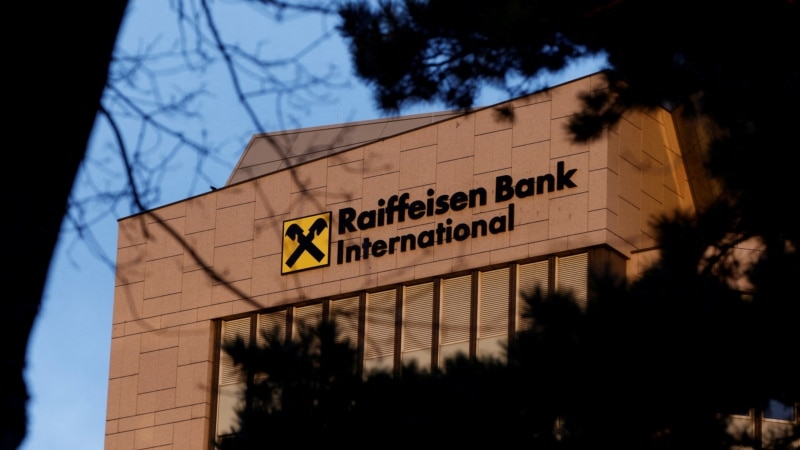
While the European measure does not involve the nationalization of any Russian federal asset, Putin’s decree intends to nationalize the property of private companies. There are an estimated 800 Western European companies operating in Russia. A few are mentioned in the decree, including the Russian subsidiary of Austria’s Raiffeisen Bank International, Italy’s UniCredit, and the German chocolatier Ritter Sport.
The shareholders and management of these companies made decisions to continue their operations in Russia and despite sanctions fully aware of the associated risks.
European regulators urged Raiffeisen to exit the Russian market starting in 2022, but the bank has been reluctant to give up the excess profits it enjoyed until recently as a near-monopoly financial institution capable of sending payments from Russia to Europe. It also balked at losing the ability to write off its Russian subsidiary as a loss.
A sale initiated by the bank is out of the question because of the conditions under which foreigners can dispose of their Russian assets. A separate decree signed by Putin requires a 50 percent discount and a 10 percent compulsory contribution to the Russian budget.
In addition, the prospects of rebuilding shaky finances through accelerated privatization of confiscated assets of foreign companies are legally dubious. The confiscated assets would be “toxic,” and the previous owners could drag the new owners through the courts. Thus, it would be difficult to find buyers, even if assets are sold off for next to nothing.


