


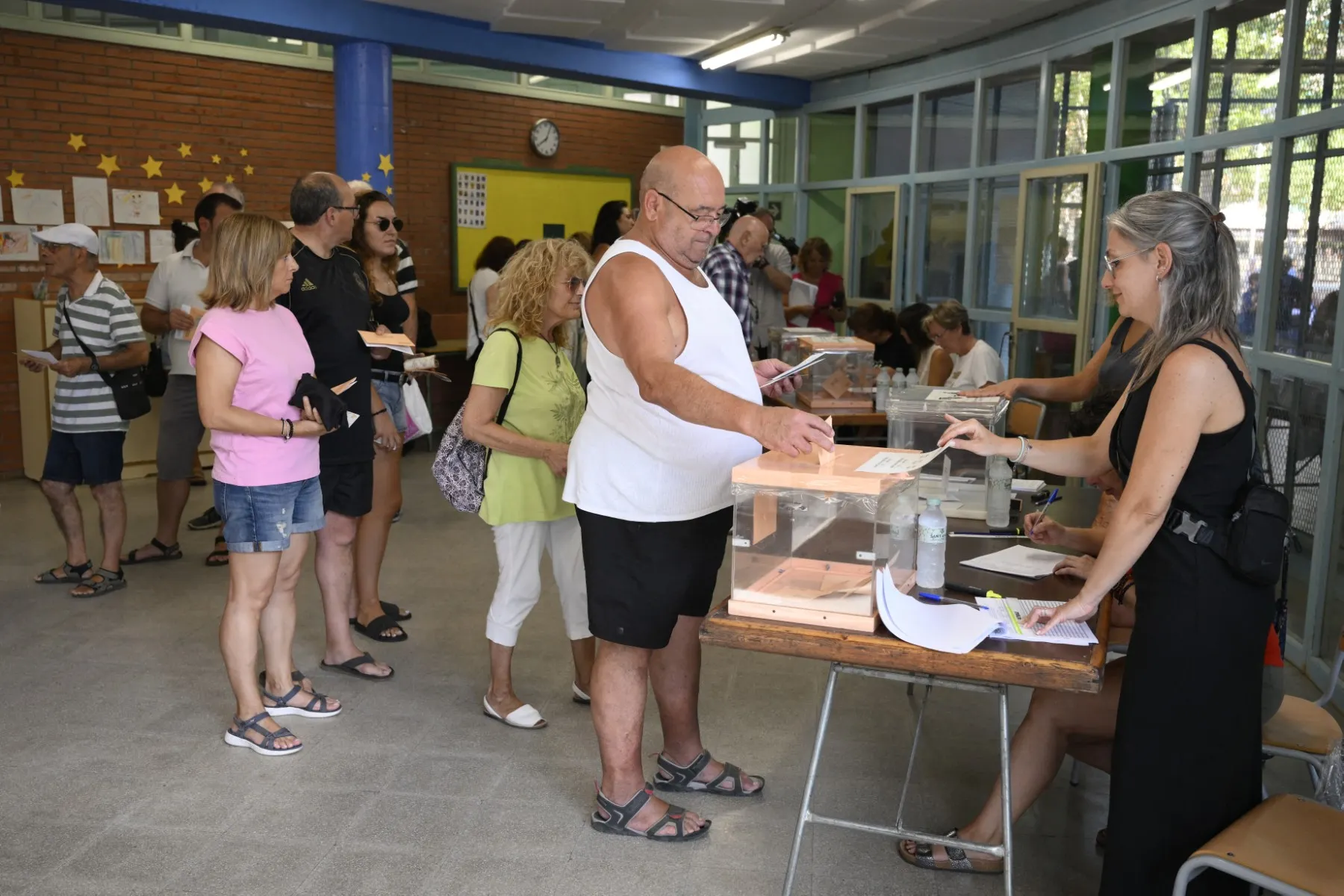
Survey data has revealed the political leanings of naturalised Spanish citizens, a group forecast to grow considerably and play an increased role in electoral politics in Spain in the coming years.
Immigration has become a highly charged political issue in Spain in recent years, like in many countries across the western world.
With far-right Vox pledging to deport millions of migrants (including those born in Spain) on one hand and the left-wing government promising mass regularisations of undocumented migrants, the debate here has become polarised.
Each bloc seemingly has its own group of ‘acceptable’ immigrants too: for the Spanish right, wealthy white European and Americans along with Latino migrants are favoured, whereas for the left refugees and asylum seekers are welcome while wealthier foreigners are to blame for property price rises and gentrification.
READ ALSO: Spain’s PP calls for points-based visa system for foreigners
However, an overlooked strand of the immigration debate in Spain is the political preferences of immigrants themselves, especially those that take Spanish citizenship and can vote in elections.
This is a growing phenomenon in Spain, with increasing numbers of foreigners becoming Spanish nationals, whether from abroad via ancestry or through residency.
A new study by Opina 360 has shed some light on their political leanings. The study, which analysed data from Spain’s Centro de Investigaciones Sociológicas (CIS) and Instituto Nacional de Estadística (INE) – the national research council and the public stats institute – also highlights the importance of this group in future elections in Spain.
Taking into account the naturalisation rate in recent years, by the end of 2025 Spain will have surpassed 3 million foreign-born residents with Spanish nationality.
READ ALSO: Spain grants citizenship via residency to 220,000+ foreigners in one year
At the last general election in 2023, there were already over 2.5 million foreign-born Spaniards with the right to vote, 7.2 percent of the electorate, so it is expected that the figure for the next elections, slated for 2027, will be around 8 percent.
“Debates on immigration focus on the increase of the foreign population in Spain. But there has also been a long trend towards an increase in the number of foreign-born residents who have acquired Spanish nationality. This social phenomenon is becoming increasingly important from an electoral point of view and could become a determining factor in the configuration of government majorities in our country in the coming years,” said director of Opina 360, Juan Francisco Caro.
So, who do they vote for?
Advertisement
Who do foreigners vote for when they gain Spanish citizenship?
In terms of parties, the polling found that the Socialists (PSOE) are the preferred option among foreign-born Spaniards overall, with 30.5 percent of direct voting intention. This was more than 10 percent above the centre-right Partido Popular (PP) in second place with 18.7 per cent. In recent European elections, the PP made a conscious effort to court foreign voters in Spain.
Up to 8.2 percent backed Vox, 3.3 percent Sumar, the far-left junior coalition partner in the Sánchez government, and 1.9 percent hard-left Podemos.
Interestingly, Vox’s voting intention among this group, 8.2 percent, is not far from its 9.3 percent among native Spaniards.
Advertisement
In terms of preferences by broader ideological blocs, naturalised Spaniards are generally more left-leaning than Spaniards of Spanish origin.
According to the CIS voting intention data, the left (including PSOE, Sumar, and Podemos) and the right (PP, Vox, and online far-right agitator group SALF) shared similar results among those born with Spanish nationality, 30 percent and 29.7 percent respectively, whereas the left block had a 5.7 percent lead among naturalised citizens.
However, it is also worth noting that there’s a notable difference in turnout between native-born and naturalised Spaniards. Eighty-five percent of native-born Spaniards polled claimed to have voted recently, compared with 66 percent of those born abroad, a gap of almost 20 percent.
Furthermore, the report also demonstrates how naturalised Spaniards do not form a homogeneous electoral bloc, but that their backgrounds and origins have a significant influence on their ideological positions and voting choices.
By continent, those born in Latin America, the largest group, are evenly distributed between the left (32.1 percent) and the right (30.3 percent), although with differences according to origin, while those from other European countries and Africa tend to be more left-leaning.
According to country of birth, Spanish nationals born in Morocco stood out as the most progressive, with the left leading the right by almost 45 percent, while those born in Venezuela were the most conservative voter group: 28.9 percent in favour of the right.
Immigrants from former Communist countries in Latin America, such as Cuba and Venezuela, can often be very sceptical of anything deemed left-wing or using the ‘Socialist’ name or brand and are more reluctant to vote for them.
READ ALSO: Will Spain’s PP protect foreigners’ rights if they get into power?


