


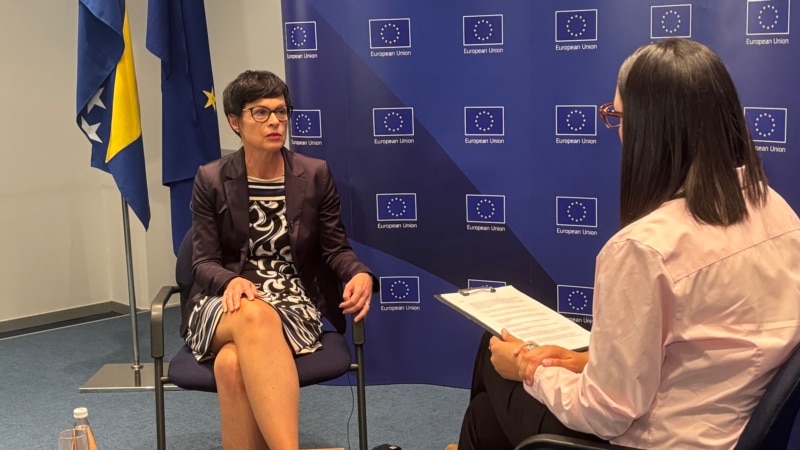
The European Commission is aware of Russia’s attempts to influence Moldova’s September 28 parliamentary elections and is examining “how it was possible” that dozens of Moldovans were reportedly trained in Serbia in destabilization tactics, Enlargement Commissioner Marta Kos told RFE/RL.
Speaking to RFE/RL’s Balkan Service, Kos praised the Moldovan government for uncovering the alleged plan, saying that “it has proven to be resilient and capable of fighting back the forces that would like to see this country going away from the European path or to see the European Union fail.”
Her remarks on September 23 came a day after Moldovan police and prosecutors detained 74 people on suspicion of preparing mass unrest.
Investigators say that, between June and September, groups of Moldovans aged 19 to 45 traveled to Serbia, where Russian instructors taught them how to break through police cordons, resist security forces, and use rubber batons, handcuffs, and even firearms.
Some reportedly entered Serbia under the guise of pilgrimages to Orthodox churches, only to be recruited for training in exchange for 400 euros ($470) per trip.
Moldovan officials said many detainees were cooperating with investigators and that prosecutors will seek arrest warrants for at least 12 suspects, while others are expected to be released. As part of the probe, passports, foreign bank cards, SIM cards, cash, weapons, and tents were seized during 250 searches.
Serbian authorities have not yet responded to RFE/RL’s requests to comment on the findings of the Moldovan investigation.
Rapid-Response Team
Although Moscow has repeatedly denied meddling in Moldova’s politics and dismissed accusations of disinformation as unfounded, Moldovan President Maia Sandu has described the former Soviet republic’s September 28 ballot as “the most important election” in the country’s history, accusing the Kremlin of spending “hundreds of millions of euros to buy hundreds of thousands of votes.”
Her allegations echo previous warnings.
Ahead of last year’s presidential vote and a referendum on enshrining Moldova’s EU bid in the constitution, the country’s intelligence services reported that more than 100 young people had been trained in Russia, Bosnia-Herzegovina, and Serbia with similar goals of destabilization. Eleven foreign instructors were identified at the time.
Kos has described Moldova’s upcoming parliamentary elections as “crucial” and pointed to the EU’s deployment of its first-ever hybrid rapid response team to support Chisinau.
“Moldova and we all have learned so much last year when they had presidential elections there and the referendum on the EU, which is now in the constitution,” Kos said.
“I am proud that the European Union, for the first time, is deploying the so-called hybrid rapid-response team. It is a team of experts from Brussels and from the member states who are helping the government in Moldova,” she added.
“We have also analyzed the Russian narratives: what kind of lies they are spreading, what tools they are using. We know exactly where they bought votes, how much money they brought into the country, how much money went through the bank accounts.””
Kos also said that both the European Commission and EU member states have learned that in the future they need to be “much better” prepared to combat disinformation.
“In this sense, you know, we, at the European Commission level, will adopt a special shield for democracy. We will have a special program, announced by our President (Ursula von der Leyen) in the State of the Union speech — a program for media resilience,” she said.


