


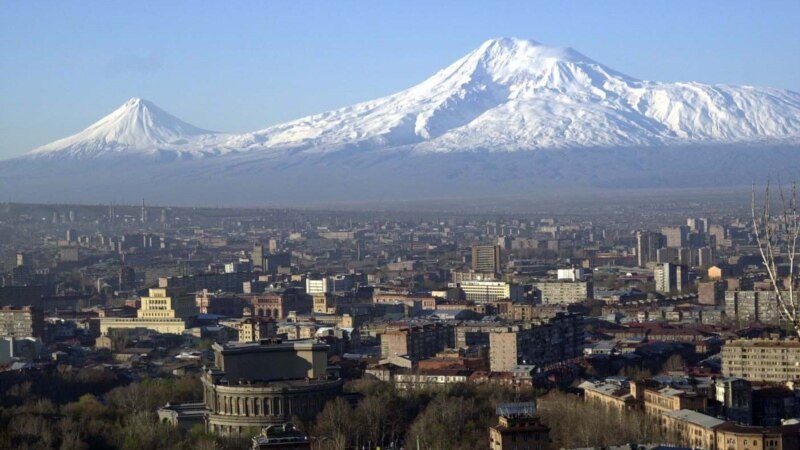
YEREVAN — For centuries, Mount Ararat has been a ubiquitous symbol for Armenians.
Its towering peaks appear on Armenia’s official coat of arms. The 5,100-meter-high mountain is also found on official passport stamps.
Popular Armenian alcohol and cigarette brands as well as a soccer team are named after Ararat. It is also a common male name in the South Caucasus country.
Just one thing: Ararat isn’t located in Armenia. It’s across the border in Turkey.
Even so, the Armenian government’s decision on September 11 to remove the image of Ararat from passport stamps has triggered an uproar.
The move comes a month after Armenia and Azerbaijan, a close ally of Turkey, signed a deal aimed at ending decades of conflict, including two full-scale wars.
Critics say the move is another concession by Armenian Prime Minister Nikol Pashinian to Turkey and Azerbaijan as he seeks to normalize relations with the country’s historical foes.
Ankara and Baku have longed objected to the presence of Ararat on Armenia’s national emblem and other official symbols, saying they amount to territorial claims.
Pashinian has defended the decision to remove the image of Ararat from official passport stamps. The move will be enforced as of November 1.
“Our task is to make the decisions that will not only ensure the security of the country within our legitimate borders today, but also for a century,” he said on September 15.
Turkey gained control of Ararat and other predominately Armenian areas in the region after signing the Treaty of Kars in 1921 with the Soviet Union.
The presence of Armenians in what is now eastern Turkey ended after the World War I-era mass killings of up to 1.5 million Armenians by the Ottoman Empire which dozens of countries consider a genocide.
Pashinian’s comments have done little to quell the concerns and anger of Armenians, many of whom see Ararat as the mythical birthplace of the Armenian people and a symbol of the tragedy of their 20th century history.
“I’m categorically against it,” a woman in the Armenian capital, Yerevan, told RFE/RL’s Armenian Service. “Mount Ararat is a symbol of Armenia.”
Ararat’s snow-covered peaks are visible from many parts of Yerevan and loom prominently over the city.
“I get inspired by Mount Ararat every day,” said another woman. “This is a symbol that will always be with me.”
Seyran Ohanian, an opposition politician, said the move over the passport stamps is intended to appease Ankara.
Turkey has kept its border with landlocked Armenia closed since the 1990s. The move has stifled trade and slowed Armenia’s economic development.
“On the one hand, they are being compelled,” he said. “On the other hand, they are doing it to please the Turks.”
History Of Animosity
The controversy over Ararat comes as Armenia and Azerbaijan appear close to signing a historic peace deal, although several key issues remain unresolved.
Last month, Pashinian and Azerbaijani President Ilham Aliyev signed a US-brokered deal aimed at finalizing a peace treaty.
Armenia and Azerbaijan’s decades-old animosity erupted into all-out conflict amid the collapse of the Soviet Union. The two sides went to war in the early 1990s over Nagorno-Karabakh, a disputed mountainous enclave. The fighting in which an estimated 30,000 people were killed ended with the region under the control of ethnic Armenians.
Despite years of international mediation, the two sides remained openly hostile.
During a six-week war in 2020, in which nearly 7,000 soldiers were killed on both sides, Azerbaijan regained much of the territory controlled by ethnic Armenians.
Three years later, Azerbaijan launched a military offensive and seized full control over Nagorno-Karabakh, compelling more than 100,000 ethnic Armenians to flee.
Since then, Armenia has, in principle, also agreed to change its constitution to remove an indirect reference to Nagorno-Karabakh, a move that would require holding a referendum. The sides also began delimitating and demarcating their shared border.
The Armenian opposition has denounced the controversial border demarcation and further diplomatic moves by Yerevan as “capitulation,” calling for Pashinian’s resignation.
But sustained opposition street protests and rallies that drew thousands last year eventually fizzled out, with Pashinian claiming that his government’s pursuit of sustainable peace enjoys broad public support.


