


Briefing correspondents in New York via video link, Shannon O’Hara spoke from Jalalabad on the conditions in Afghanistan just days after the magnitude 6 earthquake and its devastating aftershocks.
“We saw families whose lives had been shattered just within a few minutes,” the head of strategy for OCHA in Afghanistan said.
Left with nothing
“The earthquake had destroyed their homes, their farms and their livelihoods, leaving them with absolutely nothing.”
OCHA has managed to reach 49 damaged villages in the Nangarhar, Kunar and nearby affected provinces in eastern Afghanistan.
As humanitarian workers struggle to reach more regions, current reports show that nearly 40,000 people have been impacted by the earthquake, while over 5,000 homes have been destroyed.
Aid workers face challenges
“Even before the earthquake, these villages were difficult to reach,” said Ms. O’Hara. “Now, with the earthquake, it takes extraordinary effort to get there.”
A narrow, one-way road on the mountainside which was “blocked by large rocks from landslides and many vehicles trying to get up and down the valley” is the only way to get to affected areas from Jalalabad, said Ms. O’Hara.
A 100-kilometre drive took Ms. O’Hara and her team more than six and a half hours. To reach victims, first response teams have to drive – and often travel for hours on foot.
‘The heaviest burden’
Emergency responders are prioritising aid to women, children, and locals with disabilities.
“In Afghanistan, in recent years, women and girls have been pushed to the very margins of society and survival,” said Ms. O’Hara. “We know from previous earthquakes and other crises that women and girls always bear the heaviest burden.”
A estimate from UN reproductive health agency, UNFPA, shows that 11,600 pregnant women have been affected by the destruction – in a country that already has one of the highest maternal mortality rates in region.
OCHA is working to ensure that “that women are represented in health teams and more women aid workers are supporting distributions, along with nutrition, psychosocial and other counseling services,” said Ms. O’Hara.
Alarming potential for disease outbreak
The natural catastrophe has resulted in families living without clean water and sanitation in tents or “under open skies, exposed to rain and cold,” said Ms. O’Hara.
“With cholera endemic in the region and initial assessments indicating that 92 per cent of these communities are practicing open defecation, the potential for a cholera outbreak is alarming,” she continued.
While UN agencies are distributing meals and sanitation kits, efforts need to be scaled up.
“The affected communities are struggling with basic survival,” she stressed.
Urgent action needed
So far, 43,000 victims have received ready-to-eat meals and UN agencies are also providing tents, blankets and sanitation kits to assist families. But humanitarian efforts risk being disrupted if heavy rain floods IDP sites or if potential aftershocks bring more landslides. Snow from the approaching winter season is also expected to block vital roads.
“If we don’t act now, these communities may not survive the coming winter,” said Ms. O’Hara. “Additional funding is urgently needed.”
OCHA has already released $10 million for life-saving supplies and an emergency response plan is currently being finalized.
“Without immediate support the weeks ahead risk compounding this tragedy with preventable disease outbreaks, further displacement and additional loss of life.”
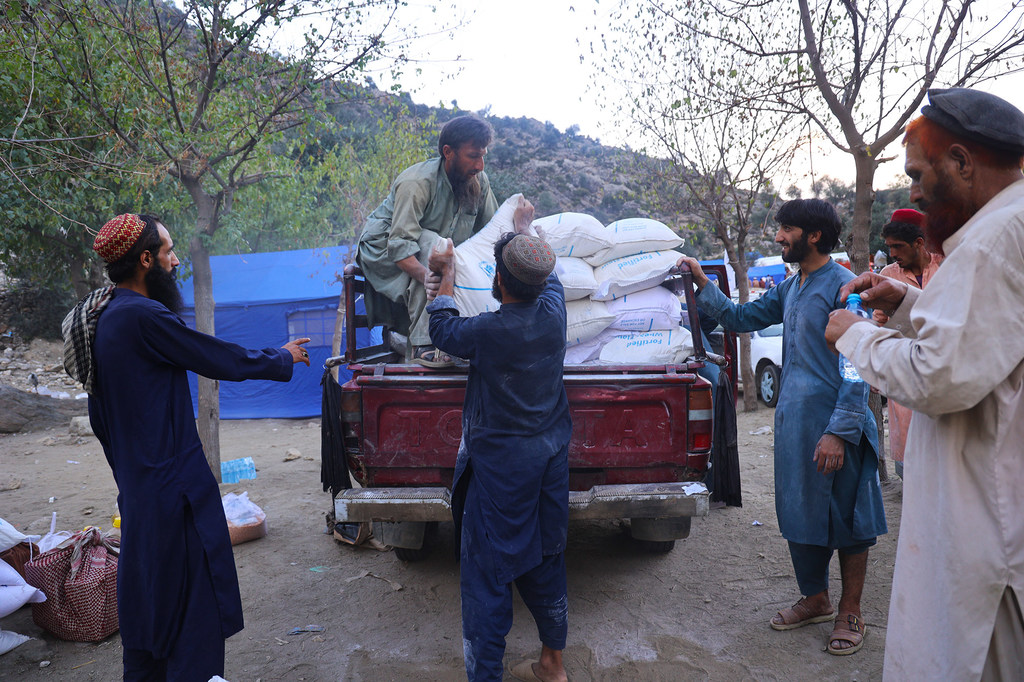
Food aid is delivered to people affected by the earthquake in eastern Afghanistan.
Fresh supplies land in Kabul
A new consignment of more than 35 metric tonnes of life-saving medical supplies landed in Kabul on Monday, to enhance the World Health Organization’s (WHO) emergency response.
WHO has now prepositioned and delivered nearly 80 metric tonnes of emergency health supplies to the country since the disaster.
The newly arrived cargo, mobilised through WHO’s logistics hub in Dubai, includes trauma and emergency surgery kits, primary health care kits, noncommunicable disease kits and essential medicines.
These supplies will be dispatched to health facilities and mobile health teams in the hardest-hit areas, following the ongoing needs assessments.


