Lausanne police scandal: training as a solution
Keystone-SDA
Generated with artificial intelligence.
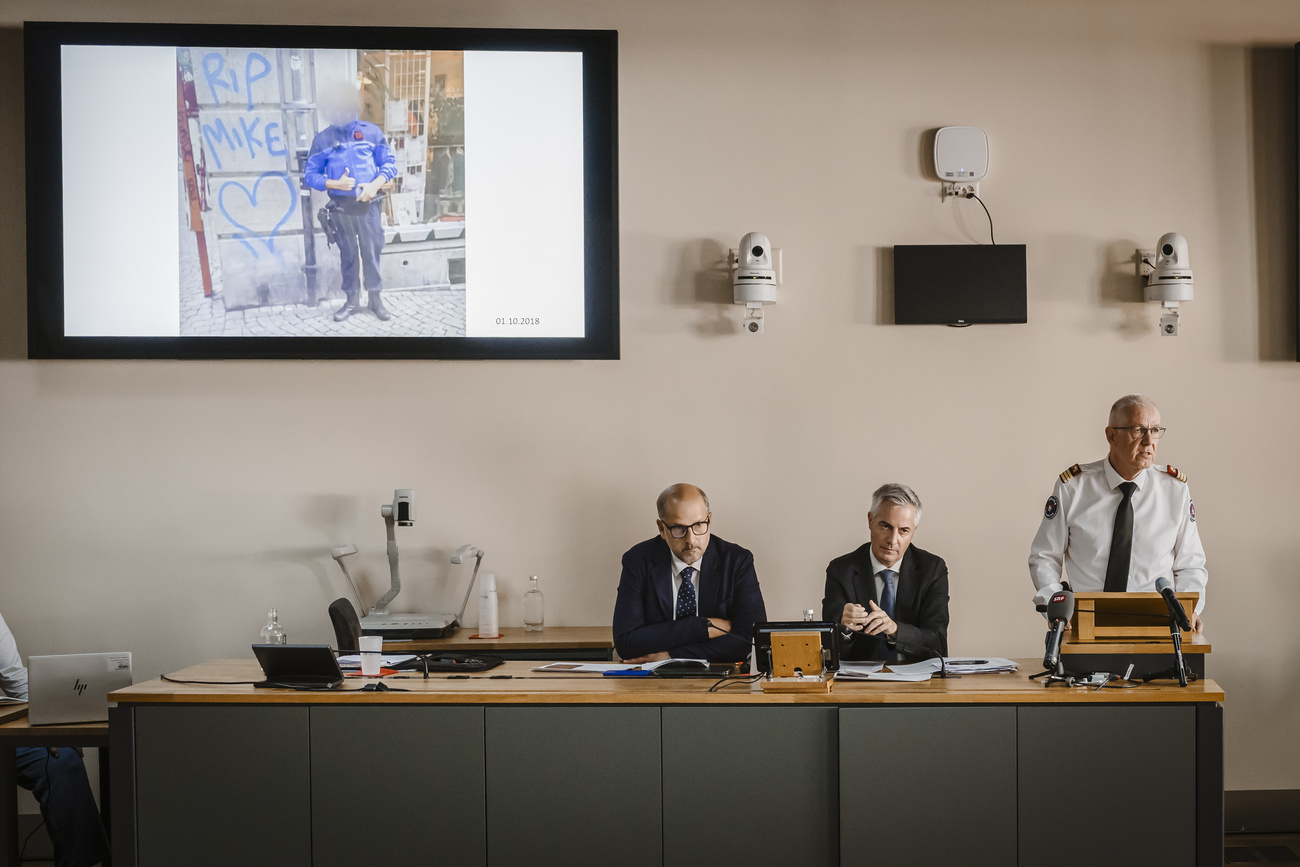
“Not all police officers deserve to be pilloried,” said Emmanuel Fivaz in an interview with Le Matin Dimanche. The president of the Swiss Federation of Police Officers (FSFP) was interviewed in the wake of the scandal over discriminatory Whatsapp messages sent by police officers.
According to Fivaz, “racist, sexist or anti-Semitic behaviour is unacceptable within the police force”. However, the President of the FSFP adds a nuance: “I do see a difference between comments that fall within the scope of the law, or of administrative measures, and a debriefing after an intervention over a drink at the end of a shift, in a purely private setting”, he explains.
Without denying the unacceptable nature of the words and images that were presented to the press at the beginning of the week, he believes that the complexity of the police profession requires a place where people can speak out.
More
More
Swiss Politics
Racist chats among Lausanne police – an isolated case in Switzerland?
This content was published on
For the first time, a culture of discrimination and systematic racism has been documented within a Swiss police force – is Lausanne a one-off case?
Fivaz points to misdirected loyalty rather than a culture of silence on racism that has been deemed “systemic” by the authorities in Vaud’s capital. He stresses the responsibility of managers in this kind of context. Their role is to refocus the teams.
Dialogue and training
For the FSFP President, training is the key. He also defends diversity in recruitment, hoping that more women and police officers of foreign origin can be integrated. Training should include civic, social and geopolitical education, as well as modules on racism and sexism. Managers must explain social and political movements to their troops.
Fivaz insists on communicating with the public. He advocates transparency in sensitive matters. He also advocates a “culture of error”, enabling police officers to progress not only technically, but also humanely, through concrete feedback.
Trust still the order of the day
With regard to the specific case of Lausanne, the Neuchâtel native points out that only 48 of the more than 500 Lausanne police officers are involved in the WhatApp groups that made headlines at the beginning of the week. “I don’t think they all deserve to be pilloried for playing down the situation,” he says.
Finally, Fivaz is banking on internal dialogue to reduce “the divide that we sometimes feel (…) between the political authorities and the police force”, while deploring that “there is perhaps an anti-police or anarchist ideology, to put it briefly, that is more prevalent in Lausanne than elsewhere”.
He concludes by expressing his conviction that “the majority of the population still has confidence in their police force and will still call 117 when they need help”.
Translated from French by DeepL/jdp
We select the most relevant news for an international audience and use automatic translation tools to translate them into English. A journalist then reviews the translation for clarity and accuracy before publication.
Providing you with automatically translated news gives us the time to write more in-depth articles. The news stories we select have been written and carefully fact-checked by an external editorial team from news agencies such as Bloomberg or Keystone.
If you have any questions about how we work, write to us at english@swissinfo.ch
More
Swiss Politics
Ex-Swiss minister Alain Berset hospitalised
This content was published on
Ex-Swiss minister Alain Berset hospitalised, prompting cancellation of his appearance at Bled Strategy Forum.
Esther Grether has died aged 89. Considered one of Switzerland’s leading entrepreneurs, the owner of the Basel-based Doetsch Grether Group was also a major shareholder in the Swatch Group and an art collector.