


It’s been a busy few weeks up on the windswept Russian archipelago of Novaya Zemlya: people, earthmoving trucks, shipping containers, temporary housing, heavy-lift aircraft, helicopters, cargo ships.
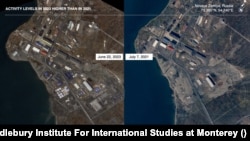
The activity shows up in satellite imagery, aircraft hazard notifications, ship transponder trackers, and open-source intelligence reporting at a time when long Arctic days and good weather mean favorable conditions for building projects at the Pankovo test range and nearby air base.
The betting money for close watchers of Russian weapons development is on another test of a trouble-plagued, nuclear-powered cruise missile called the Burevestnik.
“The operational sites for this system are almost complete. This is going to be an operational system pretty soon here,” said Decker Eveleth, a researcher at the suburban Washington-based Center for Naval Analyses, who examined satellite imagery of the sites in July and August. “This may have been the final check before operational testing and evaluation.”
“They’re clearly pretty far long,” he said.
“I wouldn’t be surprised if the test has already happened,” said Pavel Podvig, a Geneva-based arms control researcher and expert on Russia’s nuclear forces.
The missile, dubbed Skyfall by NATO, has been under development for more than a decade now. It’s one of several new systems Russian designers have focused on as the Kremlin pours money into weapons development as part of a not fully recognized arms race — mainly against the United States.
Others include the Sarmat international continental ballistic missile, a nuclear-powered, nuclear-tipped torpedo called Poseidon, and a hypersonic missile called Avangard.
Russian President Vladimir Putin talked up many of the weapons elaborate public ceremonies in 2018 and 2019. Two of the new weapons, the Kinzhal and Tsirkon missiles, have been used in Ukraine. The Sarmat has also been tested, though last year it suffered a major mishap.
The Burevestnik has drawn particular attention from arms control and intelligence experts, partly because of the technology but also its past failures.
The missile is powered essentially by a small nuclear reactor built into the engine, theoretically enabling it to stay aloft for days.
It “would carry a nuclear warhead; circle the globe at low altitude, avoid missile defenses, and dodge terrain; and drop the warhead at a difficult-to-predict location,” according to a 2019 report by the Washington-based Nuclear Threat Initiative.
U.S. intelligence reports say the missile has been tested at least a dozen times, including in 2017 and 2019.
Death At Nyonoksa
Among the places Russia has tested the Burevestnik is the White Sea, west of the city of Arkhangelsk, near the port of Severodvinsk.
In August 2019, while trying to raise a Burevestnik from the seabed near the town of Nyonoksa, an explosion occurred that spewed radiation over a wide area, including Severodvinsk. The blast also killed at least five Russian nuclear specialists from the state-owned nuclear company Rosatom, which is believed to have spearheaded the Burevestnik’s development.
The explosion, US officials later concluded, “was the result of a nuclear reaction that occurred during the recovery of a Russian nuclear-powered cruise missile.”
Two years earlier, another missile, also believed to be a Burevestnik, crashed somewhere in the Barents Sea, west of Novaya Zemlya, according to US intelligence officials.
“They’ve been developing this system for well over a decade. And it hasn’t really gone very well for a long time,” Eveleth said. “People died…and they didn’t give up. They kept going for it…. They kept going for it for 15 years. And they are really dedicated to it.”
Constant Phoenix, Nuke Sniffing
The activity at Pankovo in late July was highlighted in part by Eveleth and Jeffrey Lewis of Middlebury’s Institute of International Studies in Monterey, California. Burevestnik testing was moved out of the White Sea following the Nyonoksa accident and resumed in 2021 on Novaya Zemlya, which is more remote.
In early August, Russian authorities also released a NOTAM, according to the Barents Observer newspaper, which first reported the advisory. NOTAMs are internally recognized advisories for aircraft — a warning for pilots and ship captains, in this case, to avoid a wide area west of Novaya Zemlya.
Meanwhile, an unusually large number of fighter jets, cargo jets, and helicopters appeared parked at the Rogachevo air base on the southwestern coast of Novaya Zemlya. The aircraft appeared to include an A-50, an airborne radar and warning system experts say is rarely seen so far north; and Il-76 SKIPs, jets designed to gather electronic signals and missile telemetry data.
Open-source aircraft trackers also noted a US Air Force WC-135 jet in the airspace north of the Kola Peninsula and west of Novaya Zemlya. Known as Constant Phoenix, the jet is designed to gather samples of airborne particles to detect specific radioactive isotopes released from nuclear weapons tests.
The most recent satellite imagery, Eveleth said, suggests Russian workers have now packed up equipment on Novaya Zemlya, indicating, he said, that a test had been conducted.
‘Why Is This Such a Big Deal?’
The timing for a test was also auspicious from the point of view of Russian messaging, Lewis said in a podcast released August 20, coming around the time that Putin met US President Donald Trump for a summit in Alaska.
Another bit of evidence came on August 22 when Putin traveled to the central city of Sarov. Formerly a closed city known as Arzamas-16, Sarov has for decades been the heart of the Soviet and Russian nuclear programs: “the equivalent of Los Alamos,” Podvig said, referring to the home of the US atomic weapons program.
Among the dignitaries greeting Putin on the tarmac at Sarov was the chairman of Russia’s General Staff, General Valery Gerasimov, as well as Sergei Kiriyenko, who headed Rosatom until 2016, when he took a top post in the Kremlin.
“The combination of all these things — the test activity, the apparent preparation for deployment, and this visit — again this would be a good occasion for Putin, for the Sarov [engineers] to demonstrate that this is what we’ve done, we’ve fulfilled the assignment,” Podvig said.
“Why is this such a big deal for them?” Eveleth said. “First, the sophistication and prestige of the Russian nuclear arsenal is very important” to Putin and his government.
“Second, they’re worried about [US] missile defenses, they want to hedge against an effective missile shield and this system is technically capable of evading certain systems,” he said.


