


Switzerland is the only sovereign state with a square flag distinctive flag, but that’s not the only fact you need to know about it.
You may have heard people say (as a joke) that “Swiss flag is a big plus.” Taken literally, it is indeed true.
According to the government, “since the 14th century, a white cross on a red background has been the insignia of Swiss soldiers. When Switzerland’s federal constitution was adopted in 1848, the white cross in a red square became the country’s official national flag.”
And the rest, as they say, is history.
Here are some more interesting facts about the flag:
Switzerland is the only sovereign state in the world with a square flag
The only other square state flag belongs to Vatican City, which is independent but not technically sovereign as sovereignty is held by the Holy See.
The Swiss flag is also the only square flag flying outside United Nations headquarters in New York as Vatican City is not a member of the international organisation.
By the way, the flags of Switzerland’s 26 cantons are also square.
As to why the Swiss flag ended up square, it has been suggested that can be traced back to its history as a military standard.
Advertisement
But wait…the Swiss flag is not actually always square
While everyone thinks of the Swiss flag as being square, there are exceptions to the rule.
For the Olympic Games, for example, Switzerland uses a rectangular flag. This is because of an International Olympic Committee ruling that all national flags must have the same dimensions.
The Swiss civil ensign is also rectangular when flown by Switzerland’s sea-going merchant ships and maritime yachts. But ships on the country’s lakes and rivers usually fly the more recognisable square flag.
Advertisement
The first national flag was actually green, red and yellow
That’s right: Switzerland’s first national flag was not the distinctive version we are used to today. After the French invaded Switzerland in 1798, Napoleon introduced a green, red and yellow flag.
But that travesty disappeared with the demise of the short-lived Helvetic Republic, for which we can all be thankful, since it was created as France’s ‘sister’ republic after Napoleon’s invasion.
The first sighting of the ‘Swiss’ white cross was in 1339
In that year, soldiers with Old Swiss Confederacy attached a white cross to their armour in a bid to distinguish themselves from enemy soldiers.
This white cross was later applied to cantonal flags like that of Schwyz, where it continues to appear (in the top-left hand corner).
The flag is over 130 years old
The white cross on the red background officially became Switzerland’s national flag on December 12th 1889. Measurements were also established at the time with a decision stating that the four arms of the cross must be one sixth longer than they are wide.
Before that time, the flag had been unofficially adopted as the flag in 1848 with the birth of the Swiss confederation. But the flag itself did not feature in the 1848 constitution.
Advertisement
The red of the flag symbolises the blood of Christ (or maybe not)
There are different theories about why the Swiss flag is red. One idea is that it is a reference to the blood of Christ, while another theory holds it is a reference to the red in the flag for the canton of Bern.
By the way, there is no officially designated colour for hoisted version of the Swiss flag. However, as of 2007, the official colour of the Swiss flag for printed government logos is Pantone 485C. This is based on the so-called Pantone Color Matching System which is used internationally to ensure standardisation of colours.
And the largest Swiss flag is….
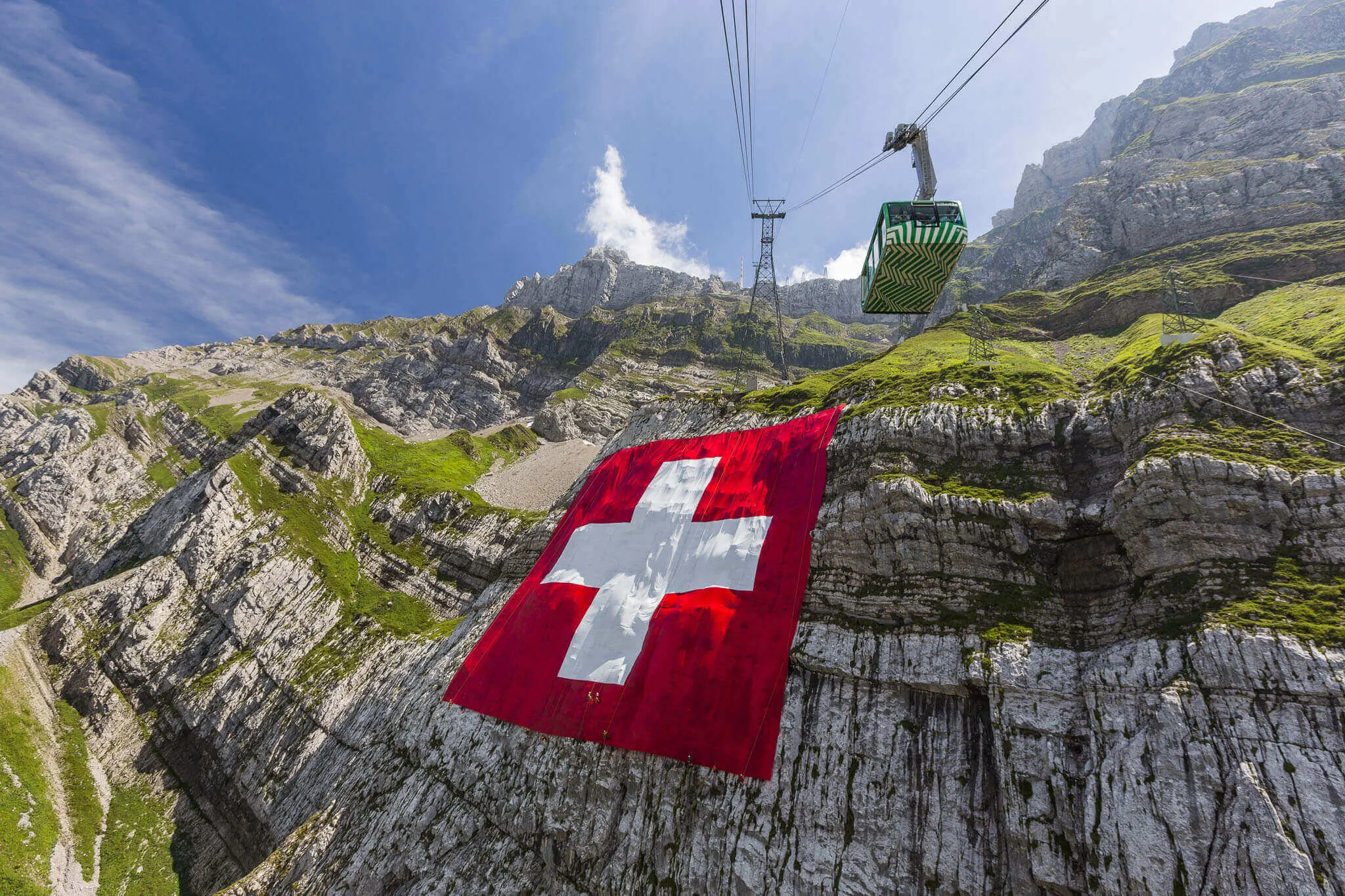
Measuring 6,400 square metres and weighing more than 700 kg, the gigantic flag is traditionally displayed on National Day, August 1st, on the north slope of the Säntis mountain (except when the weather is bad)
Though the mountain straddles the cantons of St. Gallen and Appenzell, the flag is so huge, it will is visible from much of eastern Switzerland.
READ ALSO: Is it legal to burn a Swiss flag?


